
AGC vs Modern Computers: How 74KB Took Us to the Moon
A fun and detailed comparison between the Apollo Guidance Computer and modern devices like the iPhone and gaming PCs. Discover why 74KB was more than enough to land on the Moon.
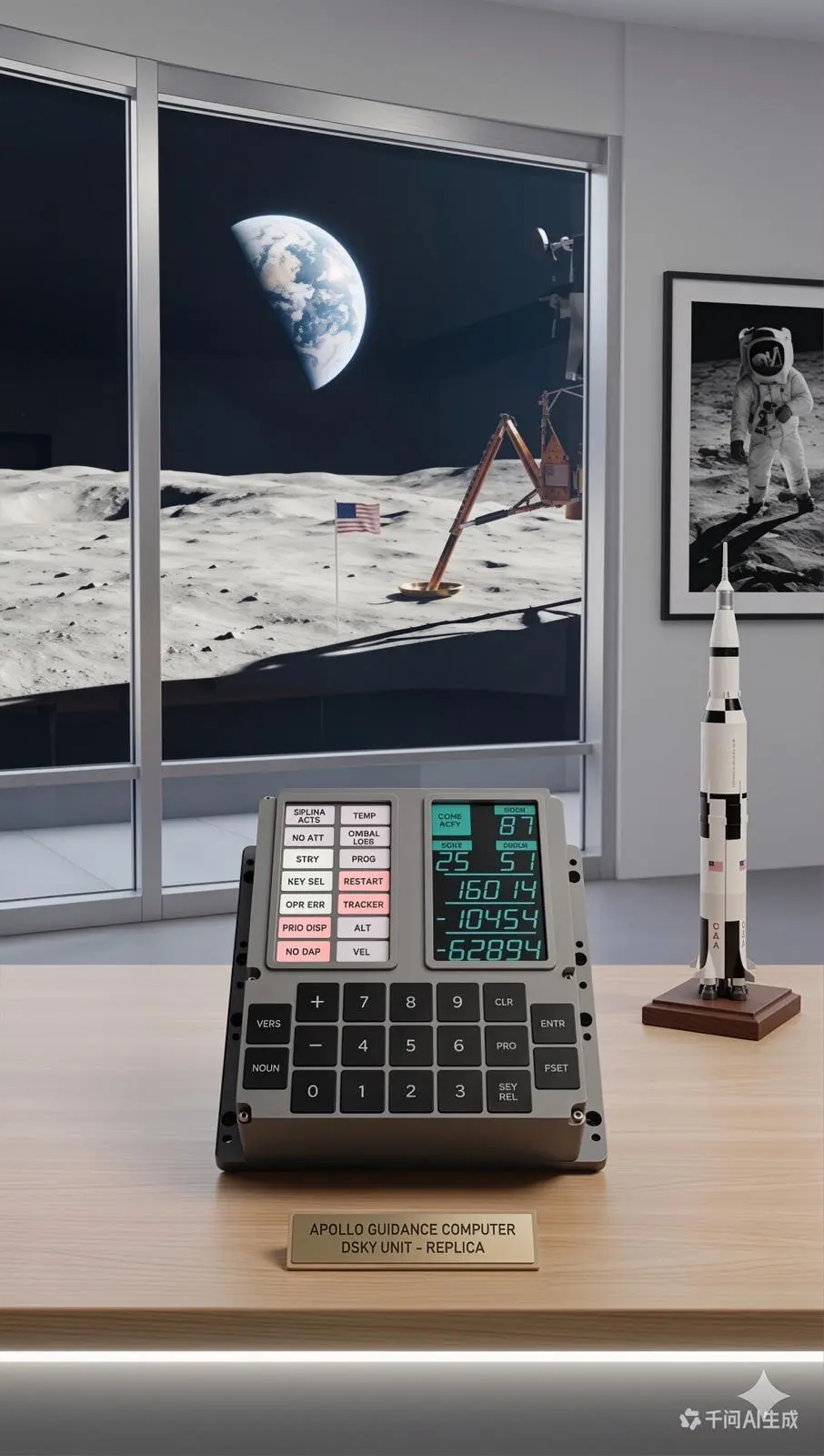
The Computer That Changed Everything
In 1969, NASA entrusted the lives of three astronauts to a computer with less processing power than a modern calculator. The Apollo Guidance Computer (AGC) had 74 kilobytes of read-only memory and a mere 4 kilobytes of RAM. Today, the background processes on your smartphone use more memory than the entire Apollo program had available. Yet this tiny machine navigated humans to the Moon and back — six times.
How is that possible? The answer reveals as much about modern software bloat as it does about the brilliance of 1960s engineering.
The Raw Numbers: AGC vs iPhone vs Gaming PC
Let us put the AGC's specifications side by side with devices you probably own.
Processor Speed - AGC: 0.043 MHz (about 43,000 operations per second) - iPhone 15 Pro: 3,460 MHz (3.46 GHz) across 6 cores - Gaming PC (Ryzen 9 7950X): 5,700 MHz across 16 cores
That means your iPhone's processor is roughly 80,000 times faster than the AGC. A modern gaming CPU is about 130,000 times faster — and that is before we count its multiple cores or the GPU.
Memory (RAM) - AGC: 4 KB (2,048 words of 15-bit erasable memory) - iPhone 15 Pro: 8 GB (8,388,608 KB) - Gaming PC: 32 GB (33,554,432 KB)
Your phone has about 2 million times more RAM. A gaming PC has roughly 8 million times more. The AGC's entire RAM could not even hold a single low-resolution JPEG thumbnail.
Storage (ROM/Disk) - AGC: 74 KB of core rope memory - iPhone 15 Pro: 256 GB to 1 TB - Gaming PC: 2 TB NVMe SSD
The iPhone's base storage is about 3.5 million times larger. A modern SSD is 27 million times larger. The AGC's entire program — the software that guided astronauts to the Moon — would fit in the space occupied by a single app icon image on your phone.
Weight - AGC: 32 kg (70 lbs) - iPhone 15 Pro: 187 g (0.41 lbs) - Gaming PC: ~15 kg (33 lbs)
The AGC weighed more than a modern gaming PC despite having incomparably less computing power.
What the AGC Could Do
Despite its tiny specifications, the AGC was extraordinarily capable within its domain:
- Real-time navigation: It continuously calculated the spacecraft's position, velocity, and orientation using data from the Inertial Measurement Unit (IMU), star tracker, and radar systems
- Powered descent guidance: The AGC computed the optimal trajectory from lunar orbit to the landing site, adjusting thrust in real time
- Rendezvous computation: It calculated the precise burns needed to reunite the Lunar Module with the Command Module in orbit
- Autopilot: The Digital Autopilot (DAP) controlled the spacecraft's attitude by firing reaction control thrusters
- Multiple concurrent programs: Thanks to its priority-based executive, the AGC could run several programs simultaneously, always ensuring the most critical task got processor time
What the AGC Could NOT Do
The limitations are equally illuminating:
- No graphics: The AGC had no display beyond the DSKY's numeric readouts and status lights. No pixels, no screens, no visual rendering of any kind
- No text processing: There was no concept of text editing, word processing, or even string manipulation as we know it
- No networking: Each AGC was an island. Communication with Mission Control happened through voice radio and separate telemetry systems
- No file system: There were no files, no directories, no storage management. Programs were literally woven into copper wire as core rope memory
- No user-friendly interface: Astronauts interacted through two-digit Verb and Noun codes. There were no menus, no help screens, no undo function
Why 74KB Was Enough
The AGC succeeded because its designers understood something that modern software development often forgets: you do not need to solve every problem — just the right ones.
Single-purpose design. The AGC did exactly one thing: guide a spacecraft. It did not need to run a web browser, play music, or display advertisements. Every byte of its 74KB was dedicated to navigation, guidance, and control.
Efficient algorithms. The MIT Instrumentation Laboratory team, led by Margaret Hamilton, wrote software that was astonishingly efficient. Their fixed-point arithmetic routines packed maximum precision into 15-bit words. Their navigation algorithms used elegant mathematical shortcuts that reduced computational requirements by orders of magnitude.
Priority-based multitasking. The AGC's executive program was one of the first priority-scheduled real-time operating systems ever built. When the famous 1202 alarm fired during the Apollo 11 landing, the executive automatically dropped low-priority tasks to keep the critical descent guidance running. This was not a bug — it was exactly the kind of graceful degradation that Hamilton's team had designed.
Hardware-software co-design. The AGC team designed the hardware and software together as an integrated system. They did not have the luxury of abstraction layers, device drivers, or operating system overhead. Every clock cycle was accounted for.
The Real-Time Computing Advantage
Modern computers are fast, but they are optimized for throughput — doing as much work as possible over time. The AGC was optimized for latency — responding to events within guaranteed time bounds.
This is the fundamental difference between a general-purpose computer and a real-time system. Your gaming PC might be able to compute a lunar trajectory a million times faster than the AGC, but can it guarantee that the computation finishes within exactly 40 milliseconds, every single time, with no exceptions? The AGC could.
Real-time guarantees matter when lives are at stake. A missed deadline in a video game causes a dropped frame. A missed deadline during powered descent causes a crash on the lunar surface.
Modern real-time systems — fly-by-wire aircraft, anti-lock brakes, pacemakers — still follow many of the same principles the AGC pioneered. They use deterministic scheduling, fixed memory allocation, and carefully bounded execution times.
Lessons for Modern Software
The AGC offers a humbling set of lessons for today's developers:
- Constraints breed creativity. The AGC team could not throw more hardware at their problems. They had to think deeply about every algorithm, every data structure, every byte. The result was software of extraordinary elegance.
2. Simplicity is a feature. The Verb-Noun interface seems primitive, but it was learnable, predictable, and reliable. Astronauts could operate it under extreme stress, in bulky gloves, with their lives on the line. How many modern interfaces can say the same?
3. Test everything. Hamilton's team pioneered what we now call software engineering. They wrote extensive test procedures and ran thousands of simulations. Their discipline saved Apollo 11 when the 1202 alarm hit.
4. Design for failure. The AGC was built to degrade gracefully. When overloaded, it shed tasks instead of crashing. When astronauts entered wrong commands, it displayed OPR ERR instead of corrupting state. Modern systems could learn from this philosophy.
5. Less is more. A modern web page often weighs more than the AGC's entire program. A single JavaScript framework can exceed 74KB. Perhaps we should ask ourselves: if NASA could navigate to the Moon in 74KB, do we really need 5MB to display a restaurant menu?
The AGC's True Legacy
The Apollo Guidance Computer was not just a piece of hardware — it was a proof of concept. It proved that software could be trusted with human lives. It proved that small, focused systems could accomplish extraordinary things. And it proved that brilliant engineering can overcome seemingly impossible constraints.
The next time your computer struggles to open a spreadsheet, remember: a machine with 4KB of RAM once landed humans on another world. The problem is rarely the hardware. It is what we choose to do with it.
At Apollo Replica DSKY, we build faithful replicas of the AGC's interface — the DSKY — so you can hold a piece of this engineering legacy in your hands. Connect it to yaAGC and run the actual Apollo flight software, or use it with Home Assistant to bring that 1960s mission control aesthetic to your smart home.