
Apollo 11: Minute-by-Minute Moon Landing Timeline
The complete Apollo 11 timeline from launch on July 16, 1969 to splashdown on July 24: TLI, lunar orbit, the 1202 alarms, Eagle's landing, first steps, and the journey home.
The Mission That Changed History
Apollo 11 was the spaceflight that first landed humans on the Moon. Commander Neil Armstrong, Lunar Module Pilot Edwin "Buzz" Aldrin, and Command Module Pilot Michael Collins launched from Kennedy Space Center on July 16, 1969, and Armstrong and Aldrin walked on the lunar surface on July 20. The mission fulfilled President Kennedy's 1961 goal of landing a man on the Moon before the end of the decade.
What follows is a detailed timeline of the mission, from liftoff to splashdown, covering the critical moments that made Apollo 11 one of the defining achievements of human civilization.
July 16, 1969 — Launch Day
09:32:00 EDT (13:32:00 UTC) — Liftoff
Saturn V rocket AS-506 lifted off from Pad 39A at Kennedy Space Center. The five F-1 engines generated 7.6 million pounds of thrust, pushing the 2,800-tonne vehicle off the pad. An estimated one million spectators lined the beaches and roads of Florida's Space Coast to watch.
09:44:00 EDT — Earth Orbit
Approximately 12 minutes after liftoff, the S-IVB third stage inserted the spacecraft into a parking orbit at 190 kilometers altitude. The crew spent the next two and a half hours verifying all spacecraft systems.
12:22:00 EDT — Trans-Lunar Injection (TLI)
Mission Control gave the "Go for TLI" call. The S-IVB's J-2 engine reignited for approximately 6 minutes, accelerating the spacecraft from 28,000 km/h to 39,400 km/h and placing it on a trajectory toward the Moon.
12:56:00 EDT — Transposition, Docking, and Extraction
Collins separated the Command/Service Module *Columbia* from the S-IVB, turned it 180 degrees, and docked with the Lunar Module *Eagle*. He then pulled the LM free from the S-IVB. The combined spacecraft stack was now heading for the Moon.
July 16-19 — The Coast to the Moon
The three-day transit to the Moon was a period of relative calm. The crew performed navigation checks using the spacecraft's sextant to sight on stars, monitored systems, and made two scheduled midcourse corrections — brief engine burns to fine-tune the trajectory.
Television broadcasts from the spacecraft showed the crew in weightlessness and offered views of the receding Earth. On July 17, Armstrong reported that the Earth appeared "very, very small" through the navigation telescope.
The spacecraft rotated slowly in what was called a "barbecue roll" — a passive thermal control maneuver that distributed solar heating evenly across the hull, preventing one side from overheating while the other froze.
July 19, 1969 — Lunar Orbit Insertion
13:21:50 EDT — Lunar Orbit Insertion (LOI)
After traveling approximately 380,000 kilometers, the spacecraft passed behind the Moon, losing radio contact with Earth. The Service Propulsion System (SPS) engine fired for approximately 6 minutes, slowing the spacecraft enough to be captured by lunar gravity. When the spacecraft emerged from behind the Moon, Aldrin reported: "It was like perfect."
The crew entered an elliptical orbit and later performed a second burn to circularize the orbit at approximately 111 kilometers (60 nautical miles) above the lunar surface.
For the next several orbits, the crew studied the planned landing site in the Sea of Tranquility through their windows and the spacecraft's optics, confirming landmarks they had memorized during months of training.
July 20, 1969 — The Landing
13:46:00 EDT — Undocking
Collins in *Columbia* released the docking latches, and *Eagle* separated. Collins performed a visual inspection of the Lunar Module, confirming that its landing gear was properly extended: "The Eagle has wings."
15:08:00 EDT — Descent Orbit Insertion (DOI)
*Eagle*'s descent engine fired briefly to lower the orbit's low point to approximately 15 kilometers above the lunar surface — the altitude at which the powered descent would begin.
16:05:45 EDT — Powered Descent Initiation (PDI)
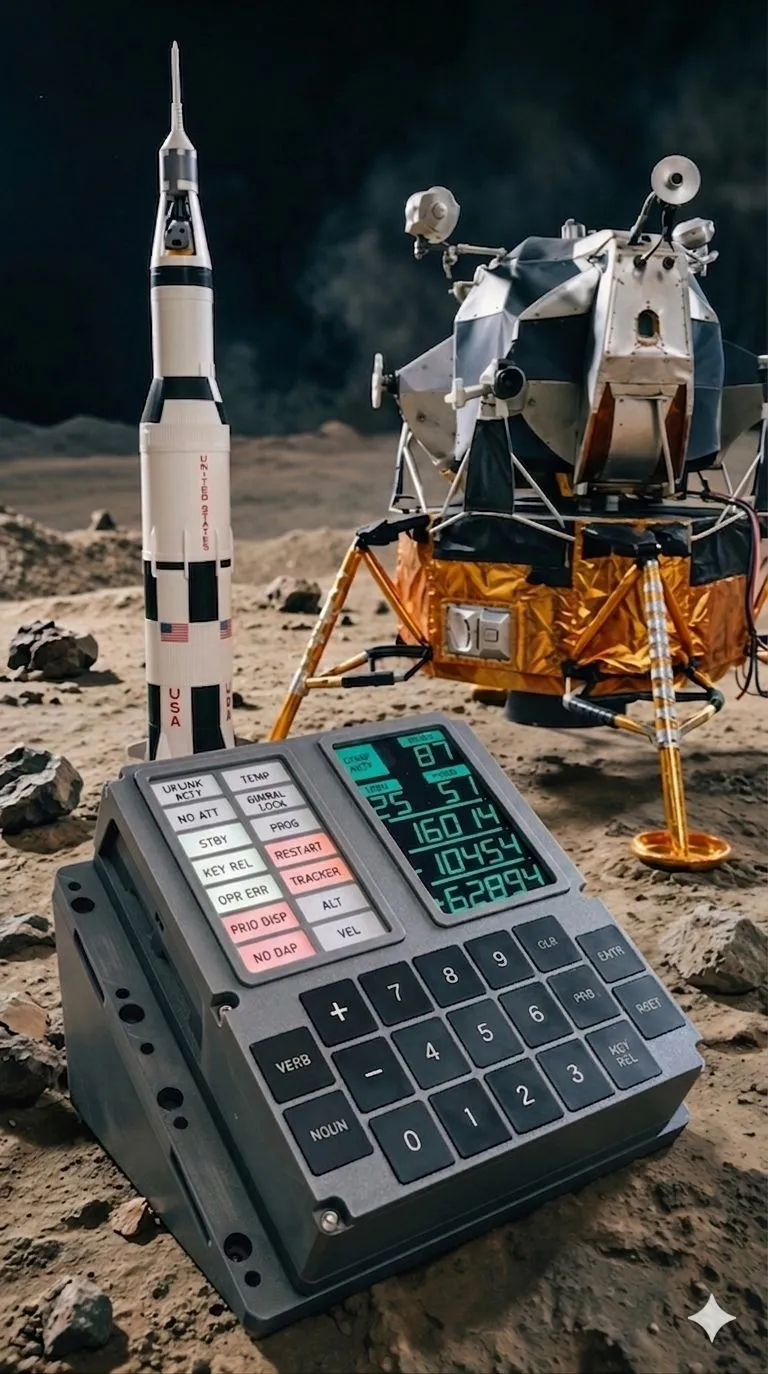
This was the moment of truth. The Lunar Module's descent engine ignited at full throttle for what would be a 12-minute burn to the surface. Armstrong and Aldrin stood at their stations, held in place by restraint cables, their eyes moving between the windows and the DSKY — the Apollo Guidance Computer's display and keyboard interface.
The AGC's Program 63 (Braking Phase) controlled the initial descent, orienting the LM with the engine pointed forward and the crew facing down toward the surface. The computer managed the throttle, gradually reducing velocity while altitude decreased.
16:10:00 EDT — The 1202 Alarm
At approximately 9,100 meters (30,000 feet) above the surface, the DSKY flashed a 1202 program alarm. Armstrong called it out immediately: "Program alarm. It's a 1202."
In Mission Control, 26-year-old guidance officer Steve Bales had seconds to decide whether the alarm was critical enough to abort the landing. The 1202 alarm meant the AGC's computer was being overloaded — it had more tasks queued than it could process in real time. The cause was the rendezvous radar, which had been left powered on as a safety precaution and was flooding the computer with unnecessary data.
The AGC's executive software, designed by Margaret Hamilton and her team at MIT, was built to handle exactly this situation. The priority-based scheduling system automatically shed lower-priority tasks and continued processing the critical descent guidance computations. The computer was working exactly as designed.
Bales made the call: "We're go on that alarm." Flight Director Gene Kranz relayed to the crew through CapCom Charlie Duke: "Roger, we got you. We're go on that alarm."
The 1202 alarm appeared several more times during the descent, along with a related 1201 alarm. Each time, Bales confirmed "Go" and the landing continued.
16:14:00 EDT — Approach Phase (P64)
At approximately 2,300 meters (7,500 feet), the AGC transitioned to Program 64 — the Approach Phase. The Lunar Module pitched forward, giving Armstrong his first clear view of the landing site through the window. What he saw alarmed him: the computer was guiding them toward a boulder field at the edge of a large crater — later identified as West Crater, roughly 180 meters in diameter and surrounded by rocks the size of automobiles.
16:16:00 EDT — Armstrong Takes Manual Control
Armstrong switched to semi-manual control, using the hand controller to fly *Eagle* beyond the dangerous terrain. He was essentially flying the LM like a helicopter, searching for a clear, level spot to land. The AGC continued to manage the throttle and vertical descent rate while Armstrong controlled the horizontal position.
This manual flying consumed more fuel than planned. Back in Mission Control, the flight controllers watched the fuel gauges with growing anxiety.
16:17:26 EDT — "60 Seconds"
CapCom Charlie Duke relayed the warning: "Sixty seconds." This meant 60 seconds of fuel remained before a mandatory abort — the point at which the descent engine would no longer have enough propellant to safely return to orbit.
Armstrong, calm and focused, continued flying. He could see a relatively smooth area just ahead, between several small craters.
16:17:52 EDT — "30 Seconds"
"Thirty seconds." The tension in Mission Control was almost unbearable. Flight controllers gripped their consoles. Armstrong had half a minute of fuel left.
16:17:58 EDT — Contact Light
A 170-centimeter probe dangling beneath one of *Eagle*'s footpads touched the lunar surface. Aldrin called out: "Contact light." Armstrong immediately shut down the descent engine.
16:17:59 EDT — "The Eagle Has Landed"
Armstrong's voice crackled across the 380,000-kilometer gulf: "Houston, Tranquility Base here. The Eagle has landed."
Charlie Duke, his voice breaking with relief, responded: "Roger, Tranquility, we copy you on the ground. You got a bunch of guys about to turn blue. We're breathing again. Thanks a lot."
The Lunar Module had landed in the Sea of Tranquility at 0.6875° N, 23.4333° E with approximately 25 seconds of fuel remaining in the descent stage tanks.
July 20, 1969 — The First Steps
22:39:33 EDT — Hatch Opens
After several hours of post-landing checks, a meal, and preparation of their Portable Life Support System (PLSS) backpacks, Armstrong and Aldrin depressurized the LM cabin and opened the forward hatch. Armstrong backed out onto the porch on his hands and knees, then descended the nine rungs of the LM's ladder.
22:54:00 EDT — Armstrong Deploys TV Camera
Before descending to the surface, Armstrong pulled a lanyard that deployed a black-and-white television camera mounted on the LM's equipment bay. The camera captured his descent down the final steps. An estimated 600 million people worldwide watched the live broadcast.
22:56:15 EDT — "One Small Step"
Armstrong placed his left boot on the lunar surface and spoke the words heard around the world: "That's one small step for [a] man, one giant leap for mankind."
He described the surface as "fine and powdery" and noted that his boot sank in only a fraction of an inch. He could see his bootprints clearly in the fine regolith.
23:15:16 EDT — Aldrin Joins Armstrong
Buzz Aldrin descended the ladder and stepped onto the Moon. Looking around at the stark landscape, he offered his own memorable description: "Beautiful, beautiful. Magnificent desolation."
The Lunar EVA
The two astronauts spent approximately 2 hours and 31 minutes outside the Lunar Module during their single EVA (Extravehicular Activity). Their tasks included:
- Planting the American flag — A specially designed flag with a horizontal rod to keep it extended in the vacuum. Armstrong and Aldrin struggled to push the flagpole into the hard-packed soil beneath the surface dust.
2. Presidential phone call — President Richard Nixon spoke with the astronauts via a radio-telephone link from the Oval Office: "For every American, this has to be the proudest day of our lives."
3. Scientific experiments — They deployed the Early Apollo Scientific Experiments Package (EASEP), which included a passive seismic experiment to measure moonquakes and a laser ranging retroreflector that is still in use today for precisely measuring the Earth-Moon distance.
4. Sample collection — Armstrong collected a contingency sample within the first minutes on the surface (in case they had to leave quickly), and together they gathered approximately 21.5 kilograms (47.5 pounds) of lunar soil and rock samples.
5. Photography — They took numerous photographs documenting the landing site, equipment, surface features, and each other. Nearly all photographs of an astronaut on the surface during Apollo 11 show Aldrin — Armstrong carried the camera for most of the EVA.
July 21, 1969 — Ascent and Docking
13:54:00 EDT — Lunar Liftoff
After approximately 21 hours on the lunar surface, the Lunar Module's ascent stage engine fired. The ascent stage lifted off from the descent stage, which remained on the Moon as a permanent landmark. Armstrong and Aldrin rose to meet Collins, who had been orbiting alone in *Columbia* for over 21 hours.
17:35:00 EDT — Docking
The LM ascent stage docked with *Columbia*. The two crews reunited, transferred the lunar samples and equipment, and then jettisoned the *Eagle* ascent stage into lunar orbit.
July 21-24 — The Journey Home
00:55:42 EDT (July 22) — Trans-Earth Injection (TEI)
The Service Propulsion System engine fired for approximately 2.5 minutes behind the Moon, accelerating the spacecraft out of lunar orbit and onto a trajectory back to Earth. The three-day coast home was uneventful, though the crew performed midcourse corrections and continued television broadcasts.
July 24, 1969 — Splashdown
12:50:35 EDT — Splashdown
The Command Module *Columbia* splashed down in the North Pacific Ocean, approximately 1,500 kilometers southwest of Hawaii, just 24 kilometers from the recovery ship USS Hornet. The mission had lasted 8 days, 3 hours, 18 minutes, and 35 seconds.
The astronauts were immediately placed in biological isolation garments — a precaution against potential lunar microorganisms. They were then transported to a Mobile Quarantine Facility aboard the USS Hornet, where President Nixon greeted them through a window.
The crew remained in quarantine for 21 days at the Lunar Receiving Laboratory in Houston. No lunar pathogens were ever found — confirming what most scientists had expected, but which NASA could not risk assuming.
The Mission by the Numbers
- Mission duration: 8 days, 3 hours, 18 minutes, 35 seconds
- Time on lunar surface: 21 hours, 36 minutes
- EVA duration: 2 hours, 31 minutes, 40 seconds
- Lunar samples returned: 21.5 kilograms (47.5 pounds)
- Distance traveled: approximately 1,533,791 kilometers
- Lunar landing coordinates: 0.6875° N, 23.4333° E (Sea of Tranquility)
- Fuel remaining at landing: approximately 25 seconds of burn time
- Television audience for first steps: estimated 600 million people
Legacy
Apollo 11 demonstrated that human beings could travel to another world, work on its surface, and return safely. The technical achievement was staggering — from the Saturn V that launched them, to the AGC and DSKY that guided them, to the life-support systems that kept them alive in the vacuum of space.
But Apollo 11's true legacy transcends engineering. For one brief moment, humanity looked up from its divisions and saw itself reflected in the courage of three men and the dedication of 400,000 workers who made their journey possible. The bootprints Armstrong and Aldrin left in the Sea of Tranquility remain undisturbed to this day — a permanent testament to what we can accomplish when we reach for the impossible.