
Apollo 13: The Successful Failure
The complete story of Apollo 13: the oxygen tank explosion, the desperate fight for survival, and how NASA's finest hour brought three astronauts home alive.
A Routine Mission That Became a Legend
Apollo 13 launched on April 11, 1970, intended as the third crewed lunar landing mission. Instead, an oxygen tank explosion 55 hours into the flight transformed it into one of the most harrowing survival stories in the history of exploration. The crew — Commander Jim Lovell, Command Module Pilot Jack Swigert, and Lunar Module Pilot Fred Haise — never landed on the Moon. But through extraordinary ingenuity, teamwork, and courage, they made it home alive, turning what could have been NASA's greatest disaster into what Flight Director Gene Kranz would later call its "finest hour."
The Crew
Jim Lovell was one of NASA's most experienced astronauts. He had flown on Gemini 7, Gemini 12, and Apollo 8 — the first mission to orbit the Moon. Apollo 13 was to be his fourth spaceflight and his chance to walk on the lunar surface.
Jack Swigert was a late addition to the crew. The original Command Module Pilot, Ken Mattingly, was pulled from the flight just 72 hours before launch after being exposed to German measles. Swigert, a bachelor and test pilot, had been serving as backup CMP and was considered fully prepared, but the late crew change added an element of unease.
Fred Haise was a former Marine test pilot making his first spaceflight. He was slated to be the Lunar Module Pilot and would have been the sixth man to walk on the Moon.
Launch and the First Two Days
The Saturn V launch from Pad 39A at Kennedy Space Center went smoothly, with only a minor anomaly — the center J-2 engine on the S-II second stage shut down approximately two minutes early due to excessive pogo oscillations. The four remaining engines burned slightly longer to compensate, and the S-IVB adjusted its burn to achieve the correct orbit. The crew entered their trans-lunar trajectory without further incident.
The first two days of the mission were routine. So routine, in fact, that the television networks had stopped carrying live broadcasts from the spacecraft. The American public had grown accustomed to Moon missions — Apollo 13 was becoming almost boring.
That changed forever at 55 hours, 54 minutes, and 53 seconds into the flight.
"Houston, We've Had a Problem"
At 9:08 PM CDT on April 13, 1970, Swigert was performing a routine procedure — stirring the cryogenic oxygen and hydrogen tanks in the Service Module to prevent stratification of the super-cold liquids. When he activated the stir fans in oxygen tank number two, a damaged electrical wire inside the tank created a short circuit. The spark ignited the Teflon insulation within the tank.
The resulting pressure buildup blew the panel off the Service Module's bay four. Oxygen tank two was destroyed. The blast damaged oxygen tank one, which began leaking. Since the fuel cells that provided electrical power to the Command Module required oxygen and hydrogen to operate, the spacecraft was dying.
Swigert's voice came over the radio, calm but urgent: "Okay, Houston, we've had a problem here."
Lovell repeated: "Houston, we've had a problem."
CapCom Jack Lousma responded: "This is Houston. Say again, please."
Lovell: "Houston, we've had a problem. We've had a Main B Bus undervolt."
In Mission Control, the telemetry data told a terrifying story. Two of the three fuel cells were already dead. Oxygen tank two pressure read zero. Oxygen tank one was dropping steadily. The Command Module *Odyssey* had, at most, a few hours of life remaining.
The Decision: Lifeboat
The crew and Mission Control faced a stark reality: the Command Module could not sustain the crew for the four days needed to return to Earth. The only option was to use the Lunar Module *Aquarius* as a lifeboat — something it was never designed to do.
The LM was built to support two men for 45 hours on and around the Moon. It would now need to support three men for roughly 90 hours in deep space. Every system would be pushed beyond its design limits.
Flight Director Gene Kranz made a series of rapid decisions that would define the rescue. He ordered the crew to power up the LM while the CM still had enough electrical power to transfer the critical navigation data. The Apollo Guidance Computer in the LM would need the CM's current platform alignment — without it, the crew would be flying blind.
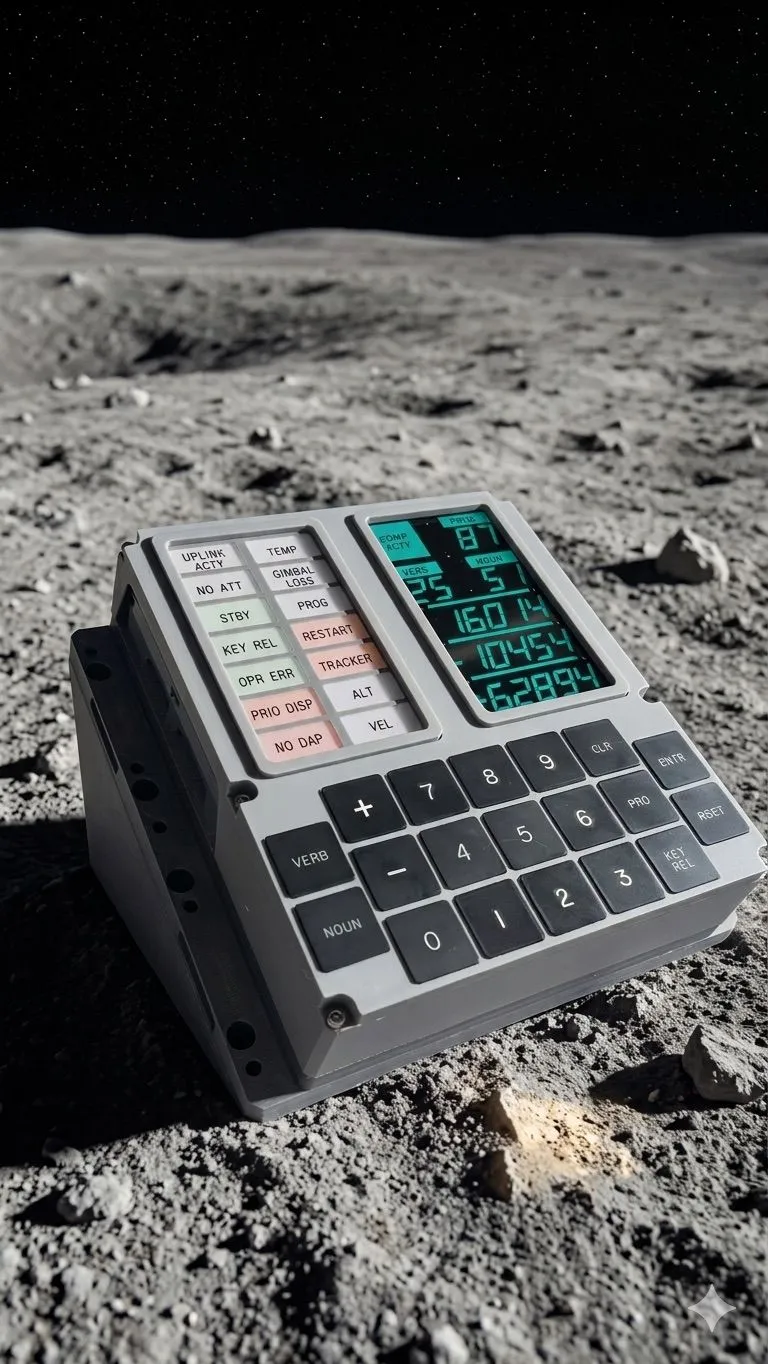
This transfer was a delicate operation. The AGC in the LM needed to receive the inertial measurement unit (IMU) alignment from the CM's computer. Using the DSKY interface, the crew entered commands to coarse-align the LM's guidance platform to match the CM's known orientation. It worked — the LM's navigation system was aligned and ready.
Powering Down
With the LM running and navigation transferred, Lovell and his crew powered down the Command Module to preserve its remaining battery power for reentry — a procedure that had never been done in flight before. The CM went dark and cold. Temperatures inside would eventually drop to near freezing.
The crew crowded into the LM, a space designed for two people to stand in while wearing spacesuits. For the next three and a half days, all three men would live, eat, and sleep in this cramped, cold spacecraft.
Mission Control also ordered the crew to minimize the LM's power consumption. Non-essential systems were shut down. The cabin was cold. Water was rationed to six ounces per person per day — one-fifth the normal intake. All three crew members suffered from dehydration, and Haise developed a kidney infection that caused him considerable pain.
The Free-Return Trajectory
At the time of the explosion, Apollo 13 was on a hybrid trajectory that would not automatically return it to Earth. A critical engine burn was needed to place the spacecraft onto a free-return trajectory — a path that would use the Moon's gravity to sling the spacecraft back toward Earth without requiring another major engine burn.
At 61 hours and 29 minutes into the mission — roughly five and a half hours after the explosion — the LM's descent engine was fired for approximately 30 seconds to adjust the trajectory. This was the first time a Lunar Module descent engine had been used for a course correction of this kind.
The burn was successful. Apollo 13 was now on a path that would swing around the far side of the Moon and return to Earth. But the estimated return time was over four days — too long for the LM's consumables to last.
The PC+2 Burn
A second, longer burn was planned for two hours after the spacecraft's closest approach to the Moon (pericynthion). This PC+2 burn would accomplish two things: speed up the return by shortening the coast time, and refine the Earth entry corridor to ensure the Command Module would hit the atmosphere at the correct angle — too shallow and it would skip off into space; too steep and it would burn up.
At 79 hours and 27 minutes into the mission, the LM's descent engine fired again for 4 minutes and 24 seconds. Without the usual precision guidance from the powered-down Command Module's systems, the crew relied on the LM's AGC and a manual technique: Lovell sighted on the Sun through the LM's alignment optical telescope and used it to verify the spacecraft's attitude. The burn was executed perfectly.
The CO2 Crisis
As the hours dragged on, a new danger emerged. The Lunar Module's lithium hydroxide (LiOH) canisters — which scrubbed carbon dioxide from the cabin air — were being consumed faster than anticipated because three people were breathing the air instead of two.
The Command Module had plenty of spare LiOH canisters, but they were square. The LM's environmental system used round canisters. The square CM canisters would not fit into the round LM receptacles — a seemingly trivial design incompatibility that now threatened to kill the crew.
Engineers in Houston worked frantically to devise a solution using only materials available aboard the spacecraft. Within hours, they developed a makeshift adapter using cardboard from flight plan covers, plastic bags, suit hoses, and duct tape. CapCom Joe Kerwin read the construction instructions up to the crew step by step.
The improvised device — which the crew nicknamed "the mailbox" — worked. Carbon dioxide levels dropped to safe limits. It was one of the most famous improvisations in engineering history.
Navigation Challenges
Throughout the return journey, navigation was a constant concern. The AGC in the LM needed periodic attitude checks, but the normal method of sighting on stars through the telescope was impossible — a cloud of debris from the explosion surrounded the spacecraft, and the glittering particles were indistinguishable from actual stars.
Lovell and the crew developed alternative navigation techniques. They used the Sun and the Earth's terminator (the line between day and night) as reference points. For one critical attitude check, they sighted on the Earth itself through the AOT (Alignment Optical Telescope) and manually entered the data into the DSKY.
Mission Control also uplinked attitude corrections computed from ground-based tracking data. The interplay between the crew's manual observations, the LM's AGC computations, and ground-based tracking represented collaborative navigation at its most desperate and innovative.
The Final Hours
As Apollo 13 approached Earth, the crew faced the daunting task of powering up the Command Module from a near-dead state. Engineers in Houston and at North American Aviation worked through the night to develop a power-up procedure that would bring the CM back to life using the limited battery power remaining, supplemented by power transferred from the LM.
The procedure was unprecedented. Every step had to be in the correct order to avoid draining the batteries before critical systems — particularly the guidance computer and the pyrotechnics that controlled parachute deployment and heat shield jettison — were operational.
At 138 hours and 38 minutes into the mission, the Service Module was jettisoned. As it drifted away, the crew got their first look at the damage. An entire panel had been blown away, and the interior was a tangle of wrecked equipment. Lovell said simply: "There's one whole side of that spacecraft missing."
The LM *Aquarius* was jettisoned next. CapCom Joe Kerwin radioed: "Farewell, Aquarius, and we thank you." The lifeboat that had saved three lives drifted away and eventually burned up in Earth's atmosphere.
Splashdown
On April 17, 1970, at 1:07 PM EST, the Command Module *Odyssey* splashed down in the South Pacific Ocean, approximately 6.5 kilometers from the recovery ship USS Iwo Jima. The crew was safe.
The mission had lasted 5 days, 22 hours, 54 minutes, and 41 seconds. The crew had traveled to the Moon and back, survived an explosion that could have killed them instantly, endured freezing temperatures and dehydration, and returned home through a reentry that tested every calculation Mission Control had made.
What Went Wrong
The subsequent investigation traced the root cause to a chain of errors and oversights:
- An oxygen tank destined for Apollo 13 had been dropped during maintenance at North American Aviation — a fall of just five centimeters, but enough to damage internal components.
- During ground testing at Kennedy Space Center, the tank failed to drain properly. Technicians used the tank's internal heaters to boil off the residual oxygen — but the heaters were powered by 65-volt ground supply current, while the tank's thermostatic switches were rated for only 28 volts (the spacecraft's bus voltage). The higher voltage welded the switches shut.
- With the thermostatic safety switches fused closed, the heaters ran unchecked, reaching temperatures of over 500 degrees Celsius inside the tank. This damaged the Teflon insulation on the internal wiring.
- When Swigert stirred the tank in flight, the damaged wires sparked, igniting the Teflon in the pure oxygen environment.
Legacy
Apollo 13 is often called NASA's "successful failure" — a mission that failed to achieve its objective of landing on the Moon but succeeded in the far more important goal of bringing its crew home alive. The rescue demonstrated the extraordinary capability of NASA's mission operations, the resilience of the Apollo spacecraft systems, and the courage of the crew.
The mission led to significant design changes in the Apollo spacecraft, including the addition of a third oxygen tank in a separate bay, removal of Teflon insulation from tank wiring, and the addition of an auxiliary battery in the Service Module.
Jim Lovell never flew in space again. Jack Swigert was elected to Congress in 1982 but died of cancer before taking office. Fred Haise commanded the Space Shuttle approach and landing tests in 1977 but never returned to space.
Their story endures as a testament to human ingenuity under pressure — proof that even when everything goes wrong, the refusal to give up can bring you home.