
The Apollo DSKY — Complete Guide to the Moon's User Interface
Everything you need to know about the DSKY: how it worked, why it mattered, and its role in every Apollo mission from Earth to the Moon.
What Is the DSKY?
The DSKY (Display and Keyboard) was the astronaut's only interface with the Apollo Guidance Computer (AGC). Pronounced "DIS-key," it served as both the display and input device that allowed crew members to communicate with the computer that would navigate them to the Moon and back.
Manufactured by Raytheon under contract to the MIT Instrumentation Laboratory, the DSKY was one of the most critical components aboard every Apollo spacecraft. Two units were installed — one in the Command Module and one in the Lunar Module.
Physical Design
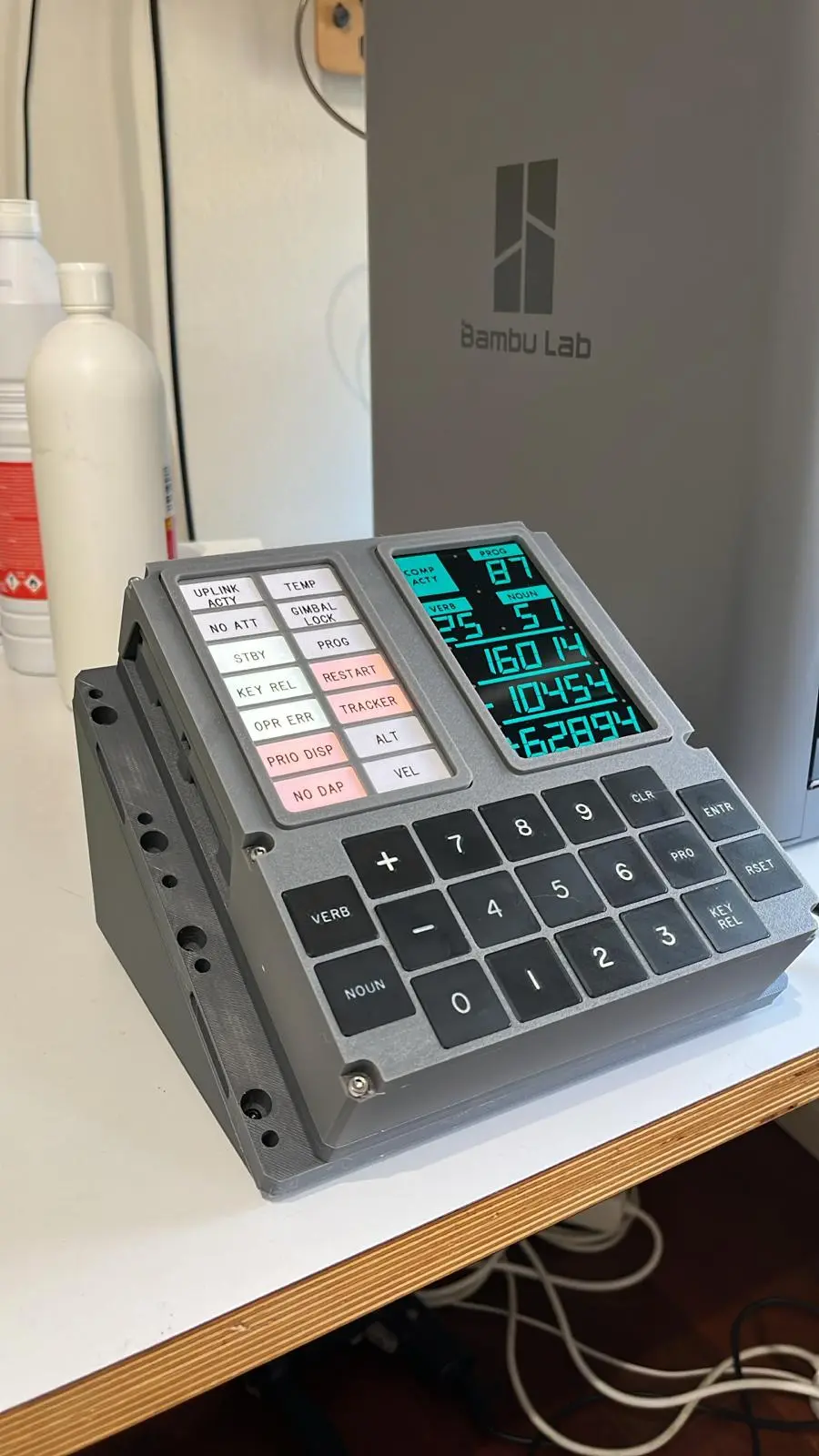
The DSKY measured approximately 8 × 8 × 7 inches and weighed 17.5 pounds (7.9 kg). Its face was divided into two main sections:
The Display Panel featured a set of electroluminescent (EL) indicators and three rows of five-digit numeric displays. The EL display used a phosphor coating that glowed when energized — a technology that was cutting-edge in the 1960s. The numeric displays showed data in octal (base-8) format.
The Keyboard consisted of 19 keys: the digits 0-9, the +/- sign key, and seven function keys: VERB, NOUN, CLR (Clear), PRO (Proceed), KEY REL (Key Release), ENTR (Enter), and RSET (Reset).
The Verb-Noun System
The DSKY used an ingenious "Verb-Noun" command system designed by MIT software engineers. To interact with the AGC, astronauts would:
- Press VERB and enter a two-digit code specifying *what action* to take
- Press NOUN and enter a two-digit code specifying *what data* to act on
- Press ENTR to execute the command
For example: - Verb 06 Noun 62 — Display velocity, altitude rate, and altitude - Verb 16 Noun 65 — Display time from ignition, abort velocity, and velocity to be gained - Verb 37 Noun 00 — Change program (the master program selector)
This system was remarkably efficient. With just two two-digit codes, astronauts could access any of the AGC's programs and data displays.
Status Indicators
The DSKY featured several critical status lights:
- COMP ACTY (Computer Activity) — Lit when the AGC was processing
- UPLINK ACTY — Lit when receiving data from Mission Control
- TEMP — Computer temperature warning
- KEY REL — Keyboard release (another program needed the display)
- OPR ERR — Operator error in keyboard input
- PROG — Program alarm (the famous 1202 and 1201 alarms)
- RESTART — Computer restart occurred
- TRACKER — Optics tracking in progress
- NO ATT — Inertial platform not aligned
- STBY — Computer in standby mode
- GIMBAL LOCK — Warning that gyroscope gimbal angles were approaching gimbal lock
The DSKY During Apollo 11
The DSKY's most dramatic moment came during the Apollo 11 lunar landing on July 20, 1969. As the Lunar Module Eagle descended toward the Sea of Tranquility, the DSKY suddenly displayed a 1202 program alarm.
The alarm indicated that the computer was being overloaded — it had more tasks to process than it could handle in real time. This was caused by the rendezvous radar being left on during descent, feeding unnecessary data to the AGC.
The priority-based executive software, designed by Margaret Hamilton and her team at MIT, saved the mission. The AGC automatically shed lower-priority tasks and continued the critical landing computations. Mission Control's Steve Bales made the call: "We're go on that alarm."
The landing continued, and Armstrong took manual control for the final descent, using the DSKY to monitor altitude and descent rate while searching for a clear landing spot.
Manufacturing and Construction
The DSKY was manufactured by Raytheon's Sudbury, Massachusetts facility. Key construction details:
- Electroluminescent display: Seven-segment digits using zinc sulfide phosphor panels driven by 800Hz AC power
- Keyboard: Mechanical pushbutton switches with positive tactile feedback, designed to work with pressure-suited gloves
- Housing: Machined aluminum case with conformal coating for thermal management
- Connectors: Heavy-duty connectors rated for the vacuum and temperature extremes of space
Each DSKY underwent extensive testing before flight qualification, including vibration, thermal vacuum, and electromagnetic compatibility testing.
Legacy
The DSKY represents a pivotal moment in the history of human-computer interaction. It was one of the first real-time, mission-critical user interfaces ever built. Its Verb-Noun command paradigm influenced later computer interface designs, and its role in Apollo stands as proof that elegant simplicity can accomplish extraordinary things.
Today, the original DSKYs are museum artifacts. The Smithsonian National Air and Space Museum, the Computer History Museum, and several other institutions display original units. At Apollo Replica DSKY, we build the most faithful replicas available — handcrafted to honor the engineering that took humanity to the Moon.