
Core Rope Memory: How Apollo Software Was Woven by Hand
The extraordinary story of core rope memory — how the Apollo Guidance Computer's software was physically woven into wires by hand, one bit at a time, by the women of Raytheon's Waltham factory.
Software You Could Hold in Your Hands
Today, software is invisible. It exists as magnetic patterns on hard drives, as electrical charges in flash memory, as fleeting signals in RAM chips. You cannot see it, touch it, or hold it. But in the 1960s, the software that guided Apollo astronauts to the Moon was different. It was physical. It was tangible. It was woven.
The Apollo Guidance Computer stored its programs in a form called core rope memory — a type of read-only memory where each bit of data was represented by a wire either passing through or bypassing a tiny magnetic core. The entire flight program for an Apollo mission was literally fabricated into hardware, one thread at a time, by skilled workers at Raytheon's factory in Waltham, Massachusetts.
This is the story of how software became textile.
How Core Rope Memory Works
Core rope memory is built from two basic elements: wires and ferrite cores. The ferrite cores are tiny toroidal (doughnut-shaped) rings made of magnetic material, typically a few millimeters in diameter. The wires are fine copper conductors threaded through and around these cores.
The encoding principle is elegantly simple:
- If a wire passes through a core, that bit is a 1
- If a wire bypasses a core (goes around it), that bit is a 0
Each core can represent one bit position for multiple words of data. A single wire threaded through a sequence of cores encodes one complete word of the program. The AGC's core rope modules contained hundreds of cores, with dozens of wires threaded through each one in carefully planned patterns.
To read a word from memory, the AGC would send a current pulse through a "sense" wire associated with the desired core. The magnetic field from the core would induce a signal on the data wires passing through it, but not on those that bypassed it. The resulting pattern of signals represented the binary data stored at that address.
This design had remarkable properties:
Permanence. Once woven, the data could not be altered — not by power failures, not by radiation, not by accidental writes. The software was as permanent as the physical wires themselves.
Density. Core rope memory achieved an impressive storage density for its era. Each bit required only a wire-core intersection, allowing the AGC to store 36,864 words (about 74 kilobytes) of program code in a package that weighed just over 10 kilograms.
Reliability. With no moving parts and no volatile storage elements, core rope memory was extraordinarily reliable. The failure rate was vanishingly small — essential for a computer that would operate in the vacuum of space, bombarded by cosmic radiation, 240,000 miles from the nearest repair shop.
The Manufacturing Process
Building a core rope memory module was one of the most labor-intensive manufacturing processes in the Apollo program. Each module took approximately two months to complete, and the process demanded extraordinary precision and patience.
Step 1: Software Freeze. Before manufacturing could begin, the software had to be complete and verified. MIT's Instrumentation Laboratory would deliver the final program as a set of binary data — essentially, a massive table of ones and zeros. Any bugs in the software at this point would be literally woven into the hardware. There was no patching core rope memory after it was manufactured.
Step 2: Wire Routing. Engineers translated the binary data into physical wire-routing plans. Each word of the program was assigned to a specific wire, and the routing of that wire through or around each core was plotted on detailed manufacturing drawings.
Step 3: Core Stringing. The ferrite cores were strung onto sense wires and mounted in precise arrays on the module substrate. This required steady hands and sharp eyes — the cores were tiny, and any misalignment could cause read errors.
Step 4: Weaving. This was the heart of the process. Workers — predominantly women — used special tools and magnifying glasses to thread each data wire through the correct sequence of cores, following the routing plans exactly. A single wire might pass through hundreds of cores. One wrong routing — one wire through a core instead of around it, or vice versa — would corrupt a word of the program.
Step 5: Testing. Each completed module was exhaustively tested against the original binary data. Every word was read and verified. If errors were found, the module had to be partially or fully rewoven — a painstaking and costly process.
The LOL: Little Old Ladies
The women who wove the core rope memory at Raytheon's factory became legends in the Apollo program. The MIT engineers affectionately — if somewhat condescendingly by modern standards — called them the LOL, short for "Little Old Ladies." In reality, they were highly skilled textile and electronics workers, many with backgrounds in the New England garment and shoe manufacturing industries.
The work required exceptional manual dexterity, patience, and attention to detail. Each weaver worked with a needle-like tool, threading thin copper wires through cores barely larger than a grain of rice, for hours at a time, in a clean-room environment. The routing patterns were complex — a single module might contain over 20,000 wire-core intersections, each of which had to be exactly right.
The LOL took immense pride in their work. They knew that the modules they wove would fly to the Moon, and that astronauts' lives depended on every wire being in the right place. Quality control was rigorous, but the weavers' own standards were even higher. Defect rates were remarkably low.
Eldon Hall, the chief hardware architect of the AGC, later acknowledged that the LOL were indispensable to the program. "Without their skills and dedication," he wrote, "we could not have manufactured the core rope modules to the quality standards required for spaceflight."
Capacity and Specifications
The AGC's core rope memory was organized into six physical modules, collectively known as the "fixed memory" (as opposed to the "erasable memory" — the small amount of read-write core memory used for variables and temporary data).
Key specifications:
- Total capacity: 36,864 words of 15 bits each (plus one parity bit per word), equivalent to approximately 74 kilobytes
- Word length: 16 bits (15 data bits + 1 parity bit)
- Access time: 11.72 microseconds per word
- Physical modules: 6 rope modules per AGC
- Weight per module: approximately 1.7 kg
- Total rope memory weight: approximately 10 kg
- Manufacturing time: approximately 8 weeks per module
For comparison, the AGC's erasable (read-write) memory used a different technology — magnetic core memory — and held only 2,048 words (about 4 kilobytes). This small amount of RAM was used for variables, counters, and intermediate calculations during flight.
The Software It Contained
The programs stored in core rope memory were among the most sophisticated software of the 1960s. For the Command Module, the software was called Colossus. For the Lunar Module, it was called Luminary. Both were written in a custom assembly language designed specifically for the AGC.
Colossus and Luminary contained:
- Navigation routines for computing spacecraft position and velocity using star sightings, radar data, and inertial measurements
- Guidance equations for computing engine burns to achieve desired orbits and trajectories
- The Executive — a priority-based real-time operating system that managed multiple concurrent tasks
- The Waitlist — a timer-based task scheduler for deferred operations
- The Interpreter — a virtual machine that extended the AGC's instruction set with trigonometric, vector, and matrix operations
- The DSKY interface — code for managing the Verb-Noun display and keyboard system
- Autopilot routines for attitude control using reaction control thrusters
- Alarm and restart logic for detecting and recovering from computer errors
All of this — an entire operating system, navigation suite, guidance computer, and autopilot — fit in 74 kilobytes of woven wire.
Core Rope vs. Modern Storage
The contrast between core rope memory and modern storage is staggering:
- A single modern USB flash drive the size of a thumbnail can hold 1 terabyte — roughly 14 million times more data than the AGC's entire fixed memory
- The AGC's 74 KB could not hold a single modern smartphone photograph
- Modern solid-state drives can read data at speeds over 7 GB/s — roughly 100 million times faster than the AGC's 11.72-microsecond access time
- A single page of modern DDR5 RAM holds more data than the AGC's entire erasable memory
Yet the core rope memory accomplished something no USB drive has: it guided human beings to the surface of another world and brought them home safely.
The End of an Era
Core rope memory was used exclusively for the Apollo program and a few other specialized applications. After Apollo, advances in semiconductor memory — EPROM, EEPROM, and eventually Flash — made core rope obsolete. These new technologies offered the ability to reprogram without physical rewiring, dramatically faster manufacturing, and much higher storage densities.
But core rope memory holds a unique place in the history of computing. It represents a moment when software and hardware were literally one and the same — when a program was a physical artifact, woven by human hands, carrying the weight and permanence of the mission it was built to serve.
A Textile Legacy
There is a poetic symmetry in the fact that the software which guided humanity's greatest technological achievement was manufactured using one of humanity's oldest technologies: weaving. The women of Raytheon who threaded those wires were the direct descendants, in a technological sense, of the textile workers who had driven the Industrial Revolution in the same New England mills a century earlier.
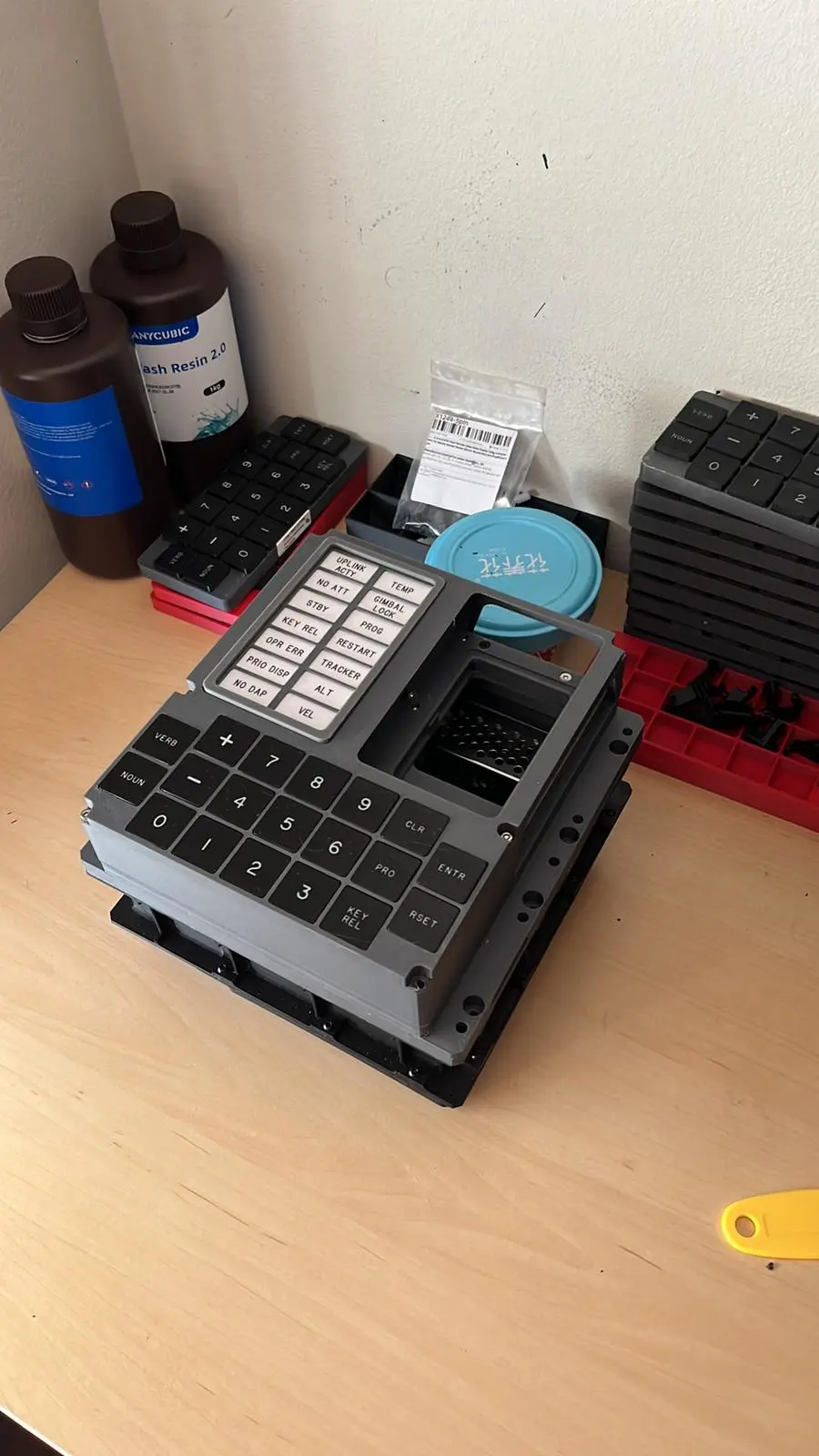
Every DSKY replica from apolloreplica.com runs software that traces its lineage back to those hand-woven modules. When the display lights up and the Verb-Noun codes appear, it is a reminder that the Moon was reached not just with rockets and computers, but with needles, wires, and the extraordinary skill of the women who wove the code that took us there.